Adam Woollacott · Conversation Designer
← All case studies Case Study

Bringing the in-store shopping experience online

A multi-retailer live chat and appointment booking chatbot that connected online shoppers with real in-store sales associates, bringing the in-store experience online across 15 enterprise retail clients.

Conversation Design Data Analytics Root-Cause Analysis Critical Thinking UI Design
My Role

Conversation Designer, Product Owner

Owned the end-to-end experience: conversational flows, UX, data, and short-term roadmap across all 15 retailers.

I took ownership of the product's direction, partnering closely with engineering, design, and leadership to shape the short-term roadmap. My work began with identifying the product's core issues, then building the reliable processes and data needed to identify drop-off and improve the user experience.

01

Conversational Flows

02

UX

03

Data

04

Short-Term Roadmap

The Problem

Getting shoppers to the right in-store assistant as fast as possible

As the product scaled, the priority was getting shoppers to the right in-store assistant as fast as possible, without long conversations or forms just to capture basic details, all while working within the existing technical architecture and ensuring data was consistent enough to demonstrate value and prioritize improvements.

Where I focused

Two areas of greatest impact

This case study focuses on two areas where I had the greatest impact.

Focus Area 01

Building an Analytics Framework to Track Conversational AI Performance

The ProblemFraming the problem

Data across clients was gapped, inconsistent, and scattered across multiple sources. This made it hard to understand where users were dropping off and demonstrate the product's value.

My AnalysisDiagnosing why

By reviewing how data was being collected and reported across the product, I then analyzed trends and compared data across multiple clients and months. This surfaced the root causes of the inaccuracy, along with where in the experience users were actually dropping off.

The DecisionWhat I changed

Rather than make incremental improvements to every client, I decided to create an analytics tool and process that would accurately pull data quickly and consistently. This included a client health score to flag which clients needed urgent attention versus which were performing well.
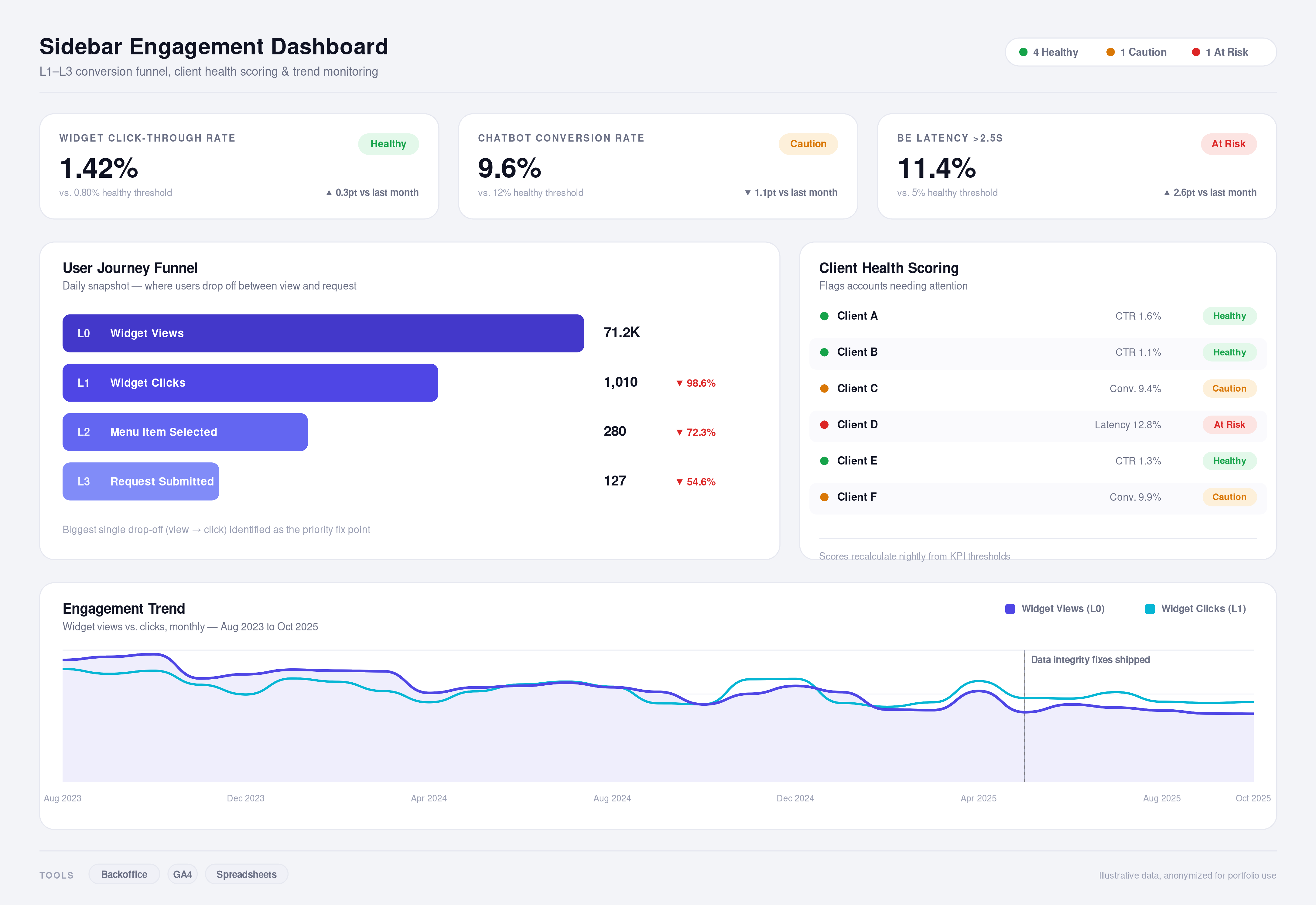
Sidebar Engagement Dashboard showing the L1-L3 conversion funnel, client health scoring, and engagement trend
Illustrative data, anonymized for portfolio use: the engagement dashboard tracking the funnel, client health scores, and trend over time.
WhyThe reasoning

For the success of the product, a standardized, reproducible process would ensure the product could continue to scale.

A one-off cleanup would have left the same recurring problem.
OutcomeWhat shipped

Shipped a standardized analytics process that cut monthly reporting time by 50%, replacing fragmented, inconsistent data with one reliable source, giving the product team a faster, clearer base for roadmap and client-health decisions.
Reporting Time
↓50%
Cut monthly reporting time by 50%
Focus Area 02

Diagnosing and Reducing Drop-off Through Conversational Analysis

The ChallengeFraming the problem

Multiple clients were seeing user drop-off within the chatbot flow, and the underlying cause wasn't clear from the data alone.

Rather than guess at a fix, I treated it as a diagnostic problem: test the cheapest, fastest hypothesis first, and only escalate once simpler options were ruled out.
My ApproachDiagnosing why

With a reliable data source now in place from Focus Area 1, funnel analysis showed a large percentage of users dropping off between the main menu and the start of individual flows. Users were viewing the menu, then leaving without entering a flow. This pinpointed the main menu as the point of failure.

WHERE USERS WERE DROPPING OFF Main menu viewed Individual flow started Users dropping off between menu and flow start Funnel analysis pinpointed the main menu as the point of failure.
Illustrative example, not the exact production funnel data.
Testing the HypothesesOne at a time
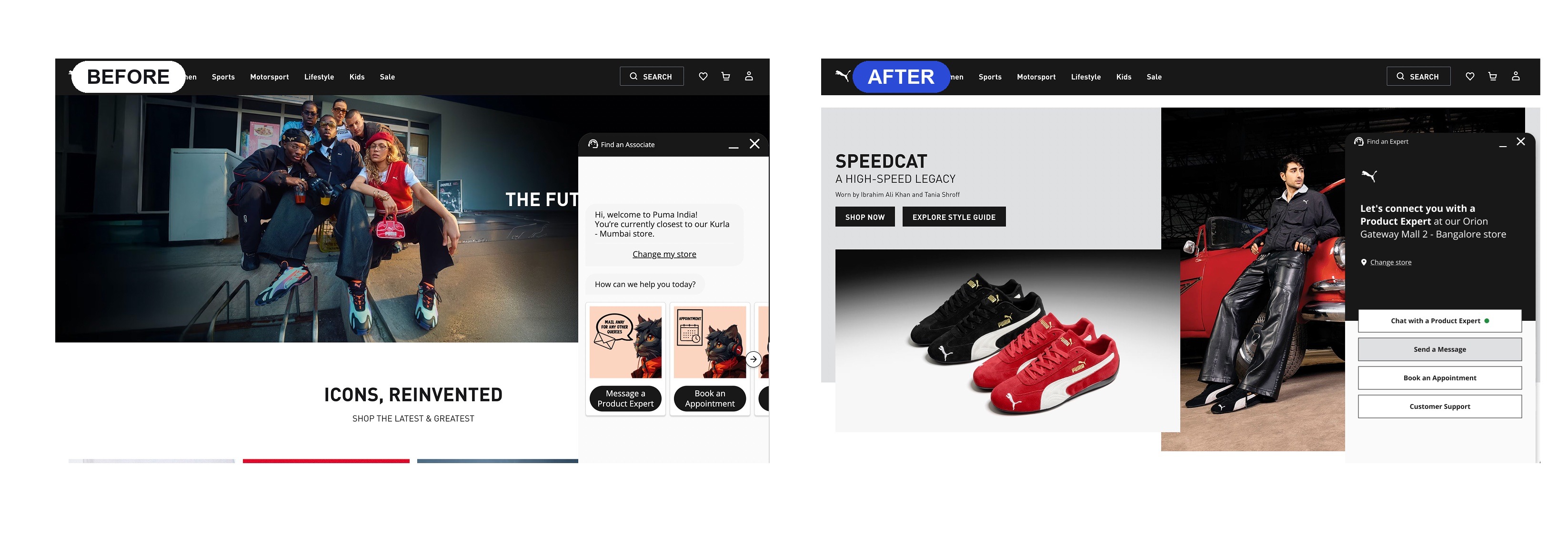
  • UI hypothesis: Usability testing surfaced recurring feedback that users disliked the number of clicks required to navigate the carousel.

    • Action: Redesigned the main menu into a cleaner list to reduce cognitive load, a low-risk, fast-to-ship change that would be easy to measure.
    • Result: A slight reduction in drop-off. An improvement, but not the root cause.
  • Clarity hypothesis: As drop-off was occurring at the first initial step, users may not have understood the bot's purpose.

    • Action: Rewrote the main menu copy to state it more explicitly.
    • Result: Another small reduction. Again an improvement, but not the root cause.
  • Technical hypothesis: With UX explanations ruled out, I suspected a technical root cause.

    • Action: Partnered with engineering to dig deeper into the logs, uncovering an issue affecting user-perceived latency.
    • Result: Once resolved, drop-off dropped significantly.
Before and after comparison of the main menu UI change, redesigning the carousel into a cleaner list
Before: the original carousel-style menu. After: the redesigned list, one of the three changes that contributed to the drop-off reduction.
AnalysisWhat it showed

Each hypothesis was tested in isolation, ruling out issues one at a time, starting with the fastest to test before committing engineering time to a deeper technical investigation. This meant spending effort on UI and copy changes that ultimately weren't the root cause, but it kept the process thorough without wasting time or cost.

OutcomeWhat shipped

30% reduction in main menu drop-off, with all three hypotheses contributing to the result.

Drop-off
↓30%
Reduction in main menu drop-off
Get in touch

Want to know more about this project?